September 13, 2026
Govern, Orchestrate, Build: How the Enterprise AI Question Fits Together


.webp)
.webp)
This complete guide to Enterprise AI Governance covers why it matters now, what the regulatory landscape requires in the UK, EU and US, which frameworks to adopt, how to build an operating model that works in practice, and how ...

Gurpreet Dhindsa
Responsible AI Director
August 11, 2026
Enterprise AI governance is the system of policies, roles, controls and oversight processes an organisation uses to ensure every AI system it builds, buys or deploys is safe, compliant, fair and accountable. It covers the full lifecycle, from how a system is designed to how it behaves once it is live.
That is the short answer. The rest of this guide covers why it matters now, what the regulatory landscape requires in the UK, EU and US, which frameworks to adopt, how to build an operating model that works in practice, and how to measure whether it is working at all.
Enterprise AI governance is the set of policies, roles, workflows and controls that ensure an organisation's use of artificial intelligence, from a single machine learning model to a fleet of autonomous agents, is safe, lawful, fair, explainable and aligned with business strategy throughout its entire lifecycle.
It is broader than any single tool or checklist. It covers four things at once.
The reason this has become a board-level topic rather than a data science one is simple. AI systems now make or influence decisions with legal, financial and reputational consequences: credit decisions, hiring, pricing, medical triage, customer communications, often without a human reviewing every output. Governance is the mechanism that keeps that delegation safe.
Why "enterprise" matters in this definition
Enterprise AI governance is distinct from governing a single AI project. A single team can write a responsible-use policy for one chatbot. Enterprise governance means the policy, the risk tiering, the review cadence and the accountability structure work consistently across every business unit, every vendor-supplied AI feature embedded in existing software, and every model an employee might use without IT ever being told. That last problem, "shadow AI", is covered in section 10.
These four terms get used interchangeably in vendor marketing, which causes real confusion at board level. They are related but distinct disciplines with different scopes and different owners.
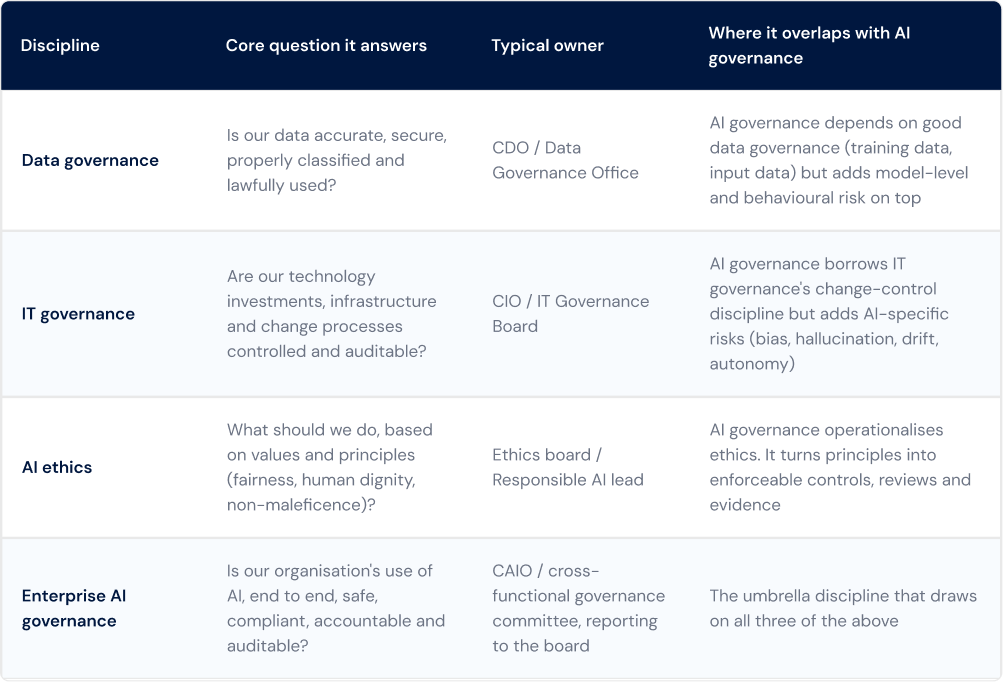
The practical distinction that matters most to leaders: data governance and IT governance are largely static. They govern assets and infrastructure. AI governance must be dynamic, because a model's behaviour can change after deployment through fine-tuning, drift, or, in the case of agentic systems, autonomous action. That is precisely why governance frameworks designed for infrastructure or datasets tend to fail when applied unmodified to AI. This is the design-time vs runtime distinction covered in section 6.
Three forces are converging in 2026 that make this a live board issue rather than a future one.
Regulatory pressure is becoming real, not theoretical. The EU AI Act's General-Purpose AI supervision and enforcement powers activate on 2 August 2026. Fines of up to €35m or 7% of global turnover are now a live exposure for any organisation operating in the EU. In the UK, the ICO, FCA and PRA are all actively rule-making on AI use in 2026, even without a standalone UK AI Act. Section 4 covers this in detail.
Trust and scale are colliding. Deloitte's eighth annual State of AI in the Enterprise report, "The Untapped Edge" (published February 2026, surveying 3,235 leaders across 24 countries), found that agentic AI usage is expected to surge from 23% of organisations today to 74% within two years. Only 21% currently report a mature governance model for autonomous agents. That gap between ambition and control is where the operational and reputational risk sits.
Governance without infrastructure is failing in practice. Netskope's 2026 AI Risk and Readiness Report found that 94% of organisations report gaps in AI-activity visibility, and only 6% consider themselves to have complete visibility into their own AI pipeline. Separately, Netskope Threat Labs' Cloud and Threat Report: 2026 (published 6 January 2026) found that 47% of generative AI users still access AI tools through personal, unmanaged accounts. Written policy is not the same as enforced governance, a distinction this guide returns to throughout.
For UK enterprises specifically, there is a fourth factor. Reputational and regulatory exposure travels faster than most internal governance programmes can move. A well-designed policy sitting in a document library provides no protection if it cannot be evidenced during a regulatory enquiry or an FCA Consumer Duty review.
Unlike data protection, where GDPR gave the world a single reference point, AI regulation in 2026 is genuinely fragmented by jurisdiction. UK enterprises typically need to satisfy all three regimes below simultaneously if they operate internationally.
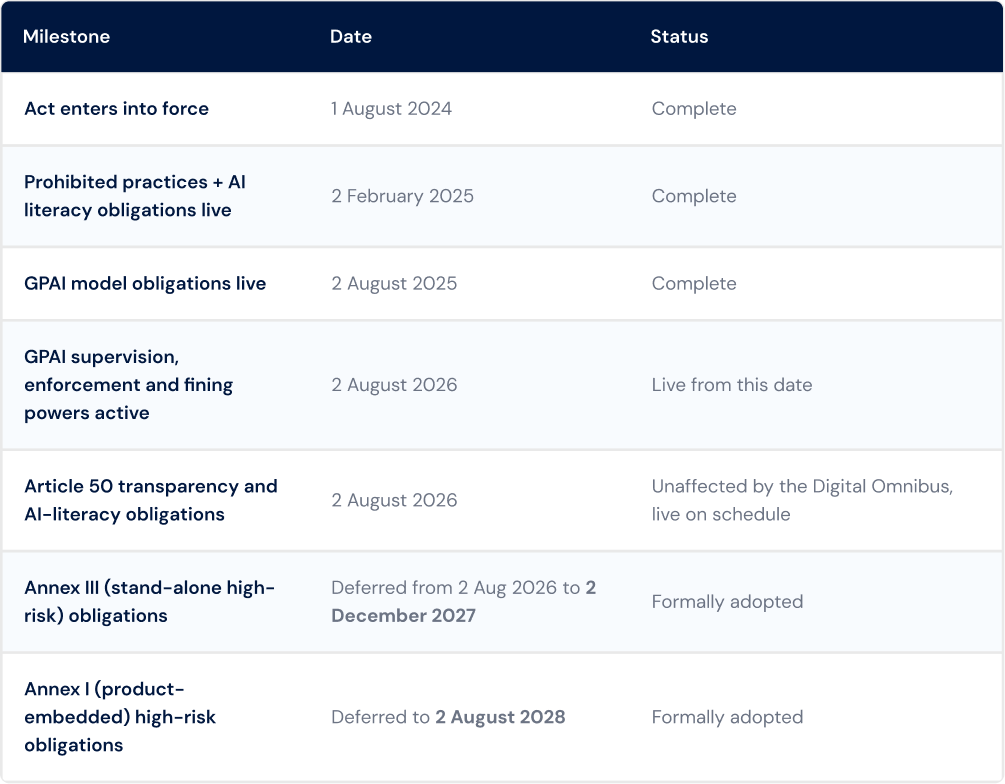
The deferral above is settled, not provisional. The Digital Omnibus on AI was formally adopted as Regulation (EU) 2026/1744, published in the Official Journal on 24 July 2026 and entering into force on 27 July 2026, days ahead of the original 2 August 2026 deadline. It is a deferral, not a dismantling: the Act's risk-based structure and its core obligations remain intact, and organisations should treat the additional time as room to prepare properly rather than a reason to stand down. Article 50's transparency and machine-readable labelling duties were not deferred and remain live from 2 August 2026.
Fines run up to €35m or 7% of global annual turnover, materially higher than GDPR's €20m/4% ceiling. Enforcement capacity remains uneven. The Future of Life Institute's national implementation tracker found that, as of 17 June 2026, only 9 of 27 EU member states had fully designated both a market-surveillance authority and a notifying authority. By 31 July 2026, roughly 190 organisations, including Google, Microsoft, OpenAI, Anthropic, Meta and Mistral, had signed the voluntary GPAI Code of Practice.
The UK has deliberately not passed an AI Act. Instead, DSIT set out five cross-sectoral principles in 2023: safety/security/robustness, transparency/explainability, fairness, accountability/governance, and contestability/redress. It left existing sector regulators to apply them. None of the five principles is directly enforceable as a standalone legal obligation. Enforceability comes through each regulator's existing powers.
The bodies that matter in practice:
The Data (Use and Access) Act 2025 is now in force, with most provisions live from 5 February 2026. A dedicated UK AI Bill has been signalled but doesn't appear to have a confirmed 2026 legislative slot. Near term, regulator-led rulemaking remains the more likely route to new obligations.
There is no comprehensive federal AI law. The most consequential recent development is at state level. The Colorado AI Act (SB 24-205), the first comprehensive US state AI law, was stayed by a federal court on 27 April 2026 after xAI sued and the DOJ intervened. It was then repealed and replaced by SB 26-189, the Automated Decision-Making Technology Act, signed 14 May 2026 and effective 1 January 2027. The replacement is significantly narrower: it drops the original risk-management programme, annual impact assessments and broad algorithmic-discrimination duties in favour of a notice-and-disclosure framework, and Colorado's Attorney General has said the new law won't be enforced until rulemaking concludes, which must happen by the January 2027 effective date.
California remains the most active state, with AB 2013 (AI training-data transparency, effective 1 January 2026), SB 942, AB 853 and new Civil Rights Council automated-decision-system employment regulations. The White House has released a National Policy Framework for AI urging Congress to pre-empt state-level AI laws entirely.
For UK enterprises, the practical takeaway is that US exposure is currently the least stable part of the regulatory picture and needs active monitoring rather than a one-off compliance exercise.
An organisation trading across the UK, EU and US cannot run one compliance checklist. The EU AI Act is risk-tiered and legally binding with hard deadlines. The UK approach is principles-based and enforced through sector regulators using existing powers. The US is a shifting patchwork of state law. A defensible governance programme must map obligations by jurisdiction and by AI system, not assume equivalence.
Regulation tells you what you must do. Frameworks and standards tell you how to build a system that can demonstrate you're doing it, which matters enormously when a regulator, auditor or customer asks for evidence.
ISO/IEC 42001:2023 is the world's first certifiable AI Management System (AIMS) standard. It shares its high-level structure with ISO 27001 and ISO 9001, which makes it straightforward to integrate into an existing management-systems environment rather than bolting on something new. It comprises 38 Annex A controls organised around 9 objectives, covering everything from AI risk assessment to data quality, resourcing, and lifecycle impact.
ISO/IEC 42001 is the first international standard against which an organisation's AI management system can be independently certified. It gives external assurance to regulators, customers and boards that AI risk is being managed systematically rather than informally.
It has now been adopted at European level as EN ISO/IEC 42001:2026 by CEN-CENELEC/JTC 21, reinforcing its position as the default reference standard for organisations operating across the UK and EU. Companion standards worth knowing: ISO/IEC 42005:2025 (AI system impact assessment), ISO/IEC 42006:2025 (requirements for AIMS certification bodies), ISO/IEC 23894 (AI risk management), and ISO/IEC 38507 (governance implications of AI for organisational bodies, the board-level standard).
Certification matters practically, not just symbolically. Several UK and EU procurement processes are beginning to treat ISO 42001 as a de facto requirement for enterprise AI vendors, and it gives a board a defensible, externally audited answer to "how do we know our AI governance actually works?"
The NIST AI RMF is voluntary and flexible rather than certifiable, organised around four functions: GOVERN, MAP, MEASURE, MANAGE. These map reasonably cleanly to ISO 42001's structure, and a NIST-published community crosswalk documents the mapping. NIST launched an AI Agent Standards Initiative in January 2026, extending the framework's relevance to autonomous systems.
For most UK enterprises operating internationally, the practical answer is not "either/or." ISO 42001 gives you a certifiable management system and audit-ready evidence. The NIST AI RMF gives you a flexible risk taxonomy that's well understood by US counterparties and regulators. Organisations with EU or UK regulatory exposure and a need for third-party assurance should treat ISO 42001 as the backbone, using NIST AI RMF's functions as a complementary risk-management vocabulary. This comparison is explored in full in the companion article, "ISO 42001 vs NIST AI RMF: Which Framework, or Both?"
The OECD AI Principles, adopted in 2019 and updated in 2024, provide the broadest point of international alignment, adhered to by 47 countries representing over 80% of global GDP. They're useful as a values-level reference point rather than an operational framework.
Most AI governance failures don't happen because an organisation lacked a policy. They happen because the policy described how AI should be built, but nobody was checking how it behaved once it was live.
This is the distinction Aligne treats as central.
Design-time governance covers everything that happens before a model or agent goes into production: risk classification, impact assessment, data quality review, bias testing, sign-off.
Runtime governance covers everything that happens after: monitoring for drift, output review, incident detection, the ability to intervene or roll back when an AI system behaves unexpectedly.
Design-time vs runtime governance: design-time governance controls what gets approved before deployment. Runtime governance controls what happens in production. An organisation with strong design-time governance and weak runtime governance can pass every internal review and still lose control of a live system.
The gap between the two is where most real-world AI incidents originate, not because the initial design review was inadequate, but because nothing was watching after go-live. This is especially acute with agentic AI, where a system's behaviour can shift meaningfully after deployment through the actions it takes, not just through retraining. Section 10 covers this in more detail.
A defensible governance programme needs both, explicitly separated in its operating model, with different owners, different review cadences and different evidence trails. Most off-the-shelf GRC tooling is built for design-time governance: policy, workflow, sign-off. It must be paired with runtime tooling, such as monitoring, guardrails and observability, to cover the full lifecycle. Section 11 explores this split further.
A working framework, regardless of which standard underpins it, needs these building blocks:
Framework components need a decision-making structure around them, or they remain documentation. A workable operating model typically has three review tiers running at different cadences:
Role clarity matters more than title. Someone, typically a Chief AI Officer, Chief Data Officer, or a designated Responsible AI lead, needs formal authority to say no to a deployment and have that decision stick. Without that, "governance" becomes advisory rather than operative. This is consistently where programmes fail in practice, regardless of how well-designed the policy documents are.
Most organisations significantly overestimate their own governance maturity. A 2025 AuditBoard study, "From blueprint to reality" (based on a survey of over 400 governance, risk and compliance professionals across the US, Canada, Germany and UK), found that only 25% of organisations have a fully implemented AI governance programme. That figure sits alongside a broader signal from MIT's Center for Information Systems Research: its four-stage Enterprise AI Maturity Model, built from a survey of 721 companies, found only around 7% of organisations reach its most advanced "AI future-ready" stage. Worth noting: the MIT CISR figure measures overall enterprise AI maturity rather than governance specifically, but the direction of travel matches AuditBoard's governance-specific finding closely enough to be a useful cross-check.
A practical five-level maturity model:
Most enterprises sit at level 2 or 3. The jump from 3 to 4, from "we have a process" to "we can prove the process runs", is where most of the governance investment should go. It's also the level at which ISO 42001 certification becomes realistic.
Agentic AI, systems that can take multi-step autonomous action rather than simply generating a single output, is moving from pilot to production faster than governance is catching up. Gartner's 26 August 2025 press release put the figure at 40% of enterprise applications expected to be integrated with task-specific AI agents by the end of 2026, up from less than 5% previously. Gartner's longer-range projection has agentic AI driving around 30% of enterprise application software revenue by 2035, surpassing $450bn. As covered in section 3, Deloitte's 2026 State of AI in the Enterprise report found that agentic AI usage is expected to surge to 74% of organisations within two years, while only 21% currently have a mature governance model for autonomous agents.
The governance implication is direct. An agent that can act, such as booking, purchasing, modifying records, or contacting customers, needs runtime controls that a static model never required: permission boundaries, action logging, and human-in-the-loop checkpoints for high-impact actions. OWASP published its Top 10 for Agentic Applications in December 2025. Singapore is reported to have published one of the first dedicated agentic AI governance frameworks in January 2026.
Shadow AI, meaning AI tools used inside the organisation without governance or IT visibility, is now a measurable, growing exposure. Netskope Threat Labs' Cloud and Threat Report: 2026 (6 January 2026) found that an average of 3% of generative AI users commit an average of 223 generative-AI data-policy violations per month, rising to roughly 2,100 per month among the top quartile of organisations, more than double the year before. The same report found that 47% of generative AI users still access tools via personal, unmanaged accounts. Separately, Netskope's 2026 AI Risk and Readiness Report found that 94% of organisations report gaps in AI-activity visibility, with only 6% reporting complete visibility into their own AI pipeline.
Shadow AI cannot be governed by policy alone. It requires technical visibility, meaning network and endpoint discovery of AI tool use, paired with a genuinely usable sanctioned alternative. Prohibition without provision reliably pushes use further underground rather than eliminating it.
Rather than building a risk taxonomy from scratch, most organisations are better served adopting or adapting an existing one. Useful starting points include the MIT AI Risk Repository, the IBM AI Risk Atlas (which organises risk by input, inference, output and non-technical categories, and is cross-mapped against MIT's Repository, NIST's Generative AI Profile and OWASP's lists via the open AI Atlas Nexus), and the NIST AI RMF Generative AI Profile.
The market has matured enough that Gartner published its first-ever Magic Quadrant for AI Governance Platforms on 17 June 2026, a signal that AI governance is now recognised as a distinct enterprise software category rather than an extension of general GRC tooling. Per a 17 February 2026 Gartner press release, spending on AI governance platforms is expected to reach $492 million in 2026 and surpass $1 billion by 2030, as fragmented AI regulation quadruples to cover roughly 75% of the world's economies. A Gartner survey of 360 organisations, conducted in Q2 2025, found that those deploying specialised AI governance platforms were 3.4 times more likely to achieve high effectiveness in AI governance than those repurposing general-purpose GRC tools.
The market splits broadly into two layers, which maps directly onto the design-time vs runtime distinction in section 6:
Choosing a platform should follow the framework, not precede it. Decide your risk tiering methodology and operating model first, then select tooling that enforces it. Aligne works across both layers, with particular depth in IBM's OpenPages and watsonx.governance stack as an IBM Gold Partner, alongside vendor-neutral advisory on the wider platform landscape.
A realistic first 90 days, sequenced to build the foundation before adding sophistication:
Days 1–30: Baseline
Days 31–60: Structure
Days 61–90: Operationalise
Beyond 90 days, the priority shifts to closing the design-time/runtime gap, pursuing ISO 42001 certification where relevant, and building the evidence base a regulator or auditor would actually want to see.
Governance metrics tend to fall into four categories, and a mature programme reports on all four rather than just the first:
Boards should expect a standing quarterly AI governance report covering all four categories, not a one-off policy sign-off. ROI is covered in full in the companion article, "Measuring AI Governance ROI."
Aligne works with UK enterprise leaders to close the gap between AI governance on paper and AI governance in production. That includes ISO/IEC 42001 gap assessment and certification readiness, led by an ISO 42001 Lead Implementer and Auditor, design-time and runtime governance architecture, and platform implementation across IBM's OpenPages and watsonx.governance stack as an IBM Gold Partner and as well as our mid-market focused AI Governance platform Altrum AI
If you are not sure where your organisation sits on the maturity model in section 9, that's usually the right place to start.
What is enterprise AI governance?
Enterprise AI governance is the system of policies, roles, controls and oversight that ensures an organisation's AI systems are safe, compliant, fair and accountable across their entire lifecycle, from design through to live production use.
What are the pillars of AI governance?
Most frameworks converge on the same core pillars: policy, accountability (roles and RACI), risk tiering, impact assessment, monitoring and incident response, and evidence/audit trail. ISO/IEC 42001 organises these into 38 controls across 9 objectives.
Who is responsible for AI governance?
Ultimate accountability sits with the board, typically delegated to a Chief AI Officer, Chief Data Officer, or Responsible AI lead who chairs a cross-functional governance committee. Accountability without the authority to block a deployment is not effective governance.
Is AI governance mandatory?
It depends on jurisdiction and use case. The EU AI Act creates binding obligations with hard deadlines and significant fines. The UK has no standalone AI Act, but existing regulators, particularly the ICO, FCA and PRA, enforce AI-related obligations through their existing powers. In practice, most enterprises need governance regardless of strict legal mandate, because customers, insurers and procurement processes increasingly require it.
AI governance vs data governance: what's the difference?
Data governance manages the accuracy, security and lawful use of data. AI governance is broader: it manages the behaviour, risk and accountability of AI systems themselves, including how they use that data, how they behave once deployed, and who is accountable when something goes wrong.
How do you implement AI governance?
Start with an AI inventory, adopt a recognised framework (ISO 42001, NIST AI RMF, or both), define risk tiering and a stage-gate review process, then build runtime monitoring for high-risk systems. Section 12 sets out a practical 90-day roadmap.
What should an AI governance policy include?
At minimum: scope and definitions, roles and accountability, risk tiering criteria, approval workflow, acceptable use rules for employees, vendor and third-party AI requirements, monitoring and incident response procedures, and review cadence.
ISO 42001 vs NIST AI RMF: which should we use?
They're complementary rather than competing. ISO 42001 is certifiable and gives external assurance. NIST AI RMF is a flexible, voluntary risk taxonomy well recognised in the US. Most internationally operating enterprises benefit from using ISO 42001 as the certifiable backbone and NIST AI RMF's functions as a working risk vocabulary.
How do you measure the success of AI governance?
Track coverage (percentage of AI systems inventoried and risk-assessed), control effectiveness (monitoring coverage, incident response time), outcomes (incident frequency and severity), and maturity progression over time. See section 13.
Should we implement data governance or AI governance first?
AI governance depends on reasonably mature data governance, so if data governance is genuinely immature, some baseline work there pays off first. In practice, most organisations run them in parallel: AI governance's inventory and risk-tiering work often exposes data governance gaps that need fixing anyway.
What is shadow AI and why does it matter?
Shadow AI refers to AI tools used within an organisation without IT or governance visibility. It matters because it's a growing and measurable exposure. Recent industry data shows most organisations have significant blind spots in AI activity visibility, which means real risk, such as data leakage and policy violations, is going undetected.
Do we need a Chief AI Officer?
Not necessarily as a standalone title, but someone needs clear, board-mandated authority over AI governance decisions, including the authority to block a deployment. Whether that sits with a CAIO, CDO, or an existing risk leader depends on organisational size and AI maturity.
What is enterprise AI governance?
Enterprise AI governance is the system of policies, roles, controls and oversight that ensures an organisation's AI systems are safe, compliant, fair and accountable across their entire lifecycle, from design through to live production use.
What are the pillars of AI governance?
Most frameworks converge on the same core pillars: policy, accountability (roles and RACI), risk tiering, impact assessment, monitoring and incident response, and evidence/audit trail. ISO/IEC 42001 organises these into 38 controls across 9 objectives.
Who is responsible for AI governance?
Ultimate accountability sits with the board, typically delegated to a Chief AI Officer, Chief Data Officer, or Responsible AI lead who chairs a cross-functional governance committee. Accountability without the authority to block a deployment is not effective governance.
Is AI governance mandatory?
It depends on jurisdiction and use case. The EU AI Act creates binding obligations with hard deadlines and significant fines. The UK has no standalone AI Act, but existing regulators, particularly the ICO, FCA and PRA, enforce AI-related obligations through their existing powers. In practice, most enterprises need governance regardless of strict legal mandate, because customers, insurers and procurement processes increasingly require it.
AI governance vs data governance: what's the difference?
Data governance manages the accuracy, security and lawful use of data. AI governance is broader: it manages the behaviour, risk and accountability of AI systems themselves, including how they use that data, how they behave once deployed, and who is accountable when something goes wrong.
Aligne's platform, Altrum AI, is currently running an Early Access Program, taking a small number of organisations that want to run it directly against their own AI systems and shape what it needs to do next. Apply here

Stay Informed: Engage with our Blog for Expert Analysis, Industry Updates, and Insider Perspectives

let’s design the governance framework your AI strategy deserves
Let's Talk.png)